
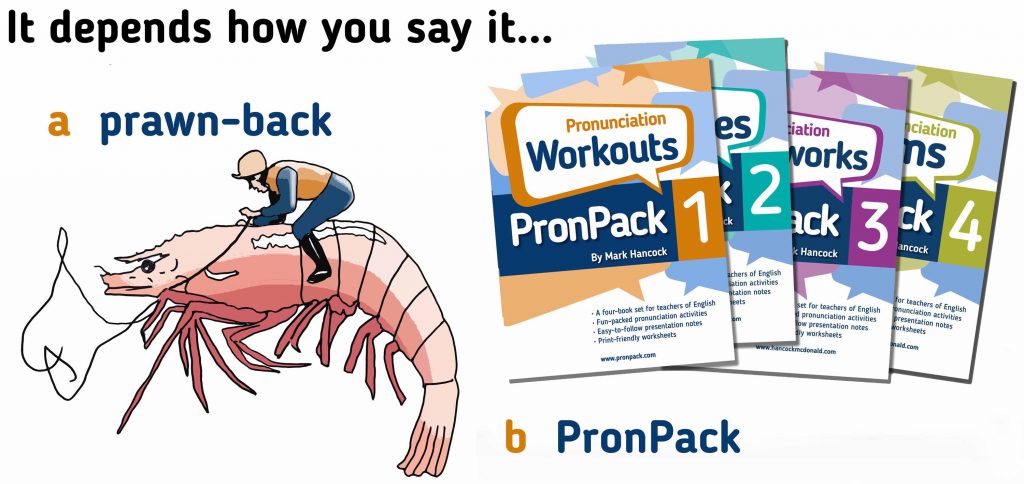
Misunderstandings are going to happen, and not only involving people who are learning the language. This example could easily be between an Australian and a British speaker.


Pronunciation made practical
Misunderstandings are going to happen, and not only involving people who are learning the language. This example could easily be between an Australian and a British speaker.

The /p/ and /b/ sounds cause problems for a lot of learners, who cannot hear or produce the difference between pairs of words like crap and crab.
Continue reading “Funny Misunderstandings”
 In my last class, a South Korean student told me about his weekend visit to Liverpool. He said it wasn’t easy to understand the local way of speaking, and gave the example of the question word What? He demonstrated how this word had been said, with the final ‘t’ replaced with a silence, or glottal stop, so it sounds like wha’? Continue reading “The Sound of Silence”
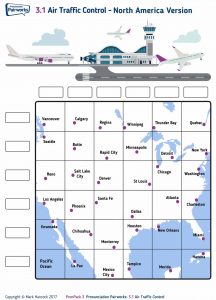
A collection of extra resources like this to be added soon to the ‘Resources’ page! Free sample downloads for this activity in the ELT Materials section at hancockmcdonald.com.
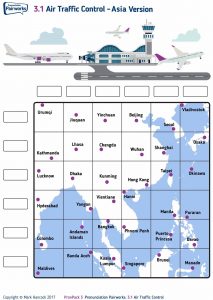
Free sample downloads for this activity here in the Materials section at Hancock McDonald ELT website.
A collection of extra resources like this to be added soon to the ‘Resources’ page!
 At the NCE conference in Ede, Netherlands. The hat means I’m in role of teacher and you’re the students. Hats off means we’re all what we are – conference participants. In teacher role, I demonstrated two task sequences for pronunciation lessons. In conference role, we discussed the pros and cons of the tasks.
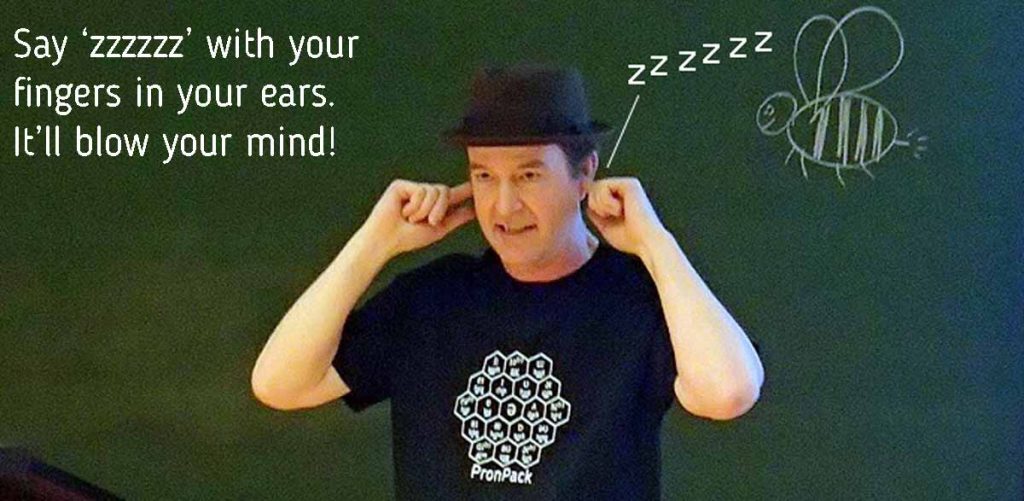
Say ‘sssssss’ with your fingers in your ears. Now do the same with ‘zzzzz’ – and hear the difference! This is me at TESOL Spain demonstrating this simple way of showing students the difference between unvoiced /s/ and voiced /z/. I love little practical experiments like this in the pronunciation class. Thanks to Daniel Barber for the photo!
 In the past, it was often assumed without further thought that learners should be taught to approximate to General British (GB) or General American (GA). Students assumed that they ought to sound like a native speaker. Teachers and published materials worked on the assumption that the model should be the native speaker accent with the widest acceptance and prestige. Indeed, this point of view is still widely held today. However, many people now question this assumption. Continue reading “Models in Pronunciation Teaching”
Each book in PronPack 1-4 is different from the others by activity-type, rather than the pronunciation points covered. Each book is a resource pack taking one particular approach to a wide range of pronunciation points. All of the books move generally from individual sounds near the beginning to suprasegmental features towards the end. Continue reading “A Pronunciation Syllabus across ‘PronPack’”